Boride Narrow Sharpening Stones are used for sharpening knives on Edge Pro sharpeners. Narrow stones (12mm wide) are suitable for recurved blades. Boride offers a wide range of stones with different performance values and different rates of wear. All Boride stones are 6mm thick and are mounted on high-quality aluminum blanks. Stones that are 6mm thick offer a longer life cycle than stock Edge Pro stones that are 3mm thick and are becoming a community standard.
Details
CS-HD series stones are made of silicon carbide and are designed for the hardest steels (up to 63 HRC). It is advisable to use the CS-HD stone set to sharpen knives made of hard stainless steel or carbon steel. Use of CS-HD stones to sharpen knives made of soft steel is not recommended – this will cause the CS-HD stones to wear at increased rates. However, the coarse CS-HD stones (120 and 150 grit) are often used as a universal coarse stone and perform well in this role. CS-HD is the second most popular of the Boride series for Edge Pro sharpening.
T2 series stones are made of aluminum oxide and use a very strong bond. As a result, these stones are high performance and their wear rate is below average. Boride recommends T2 at the best series for working with stainless steel. The T2 series is the most popular among all Boride series for Edge Pro sharpening. Many customers buy entire sets of the T2 series.

Specification
- Product size: 160 x 12 x 9mm (6" x ½" x ⅓")
- Working surface: 152 x 12 x 6mm (6" x ½" x ¼")
- Weight: 45 g (1.6 oz)
- Abrasive: Bonded Silicon Carbide
- Extra materials: Aluminum Blank, 3M PSA
How to use
Boride stones should be used with one of these lubricants:
- Water
- Soapy water
- Boride Bori-Lube
- Water solution of dipropylene glycol
- WD-40 (for experienced users only)
- Refined olive oil (for experienced users only)
- Oleic aсid (for experienced users only)
In case of using the water as lubricant, soak the stone in water for 1-2 minutes. In case of using the oil, put a small amount (1-2 drops) of honing oil on the stone’s surface and spread it evenly over the stone with a finger. If the stone absorbs the honing oil, use larger amount of oil.
Boride Stones may have the following minor defects:
- Saw strokes on the work surface
- Residues of lacquer
- Small chips at the corners and along the edges (no larger than 1mm)
All these defects will be eliminated during preparation of the stone. The majority of sharpening stones requires preparation, and Boride stones are no exception. Additional lapping can be performed by customer to improve sharpening quality. We recommend to use loose silicon carbide powder or diamond lapping plate.
FAQ
What is the difference between Boride and stock Edge Pro stones?
There is no difference. Edge Pro stones are Boride 150 x 25 x 3mm (6" x 1" x ⅛") branded as Edge Pro. Boride offers a wide variety of series and sizes, while Edge Pro offers a limited assortment. We buy sharpening stones from Boride and mount the stones to blanks. That's exactly what Edge Pro company does. The difference is we keep the names of the original sharpening stones in the names of the finished products.
Can I use Boride stones and stock Edge Pro stones simultaneously?
Yes, but you must use a thickness compensator because stock Edge Pro stones are 3mm thick, while the Boride stones we offer are 6mm thick. It's highly recommended to own a thickness compensator because the ability to use sharpening stones of different thicknesses allows for a high level of flexibility.
What if I buy Boride stones 3mm thick to keep all my collection uniform?
This is possible but not recommended as a long-term solution. The 6mm thickness is becoming a community standard for Edge Pro sharpening stones. If you keep your entire collection 3mm thick, you will not be able to use many good stones. You will also have to purchase 3mm stones more often than 6mm stones due to their shorter life cycle.
5 sharpening stones are too many for me. What should I buy?
Consider buying set of 3 stones: 150, 400 and 1200 grit.
What are the pros and cons of 6mm and 3mm thicknesses for sharpening stones?
All stones wear as they are used and thicker stones have longer life cycles as a result. However, it's easier to use thinner stones on Edge Pro sharpeners because of their lower weight. The 6mm thickness offers a perfect balance between life cycle and weight, and has become the community standard for Edge Pro format sharpening stones When made of hard material, 3mm stones are good as ultra-fine sharpening stones, for example alumina ceramic or natural stones.
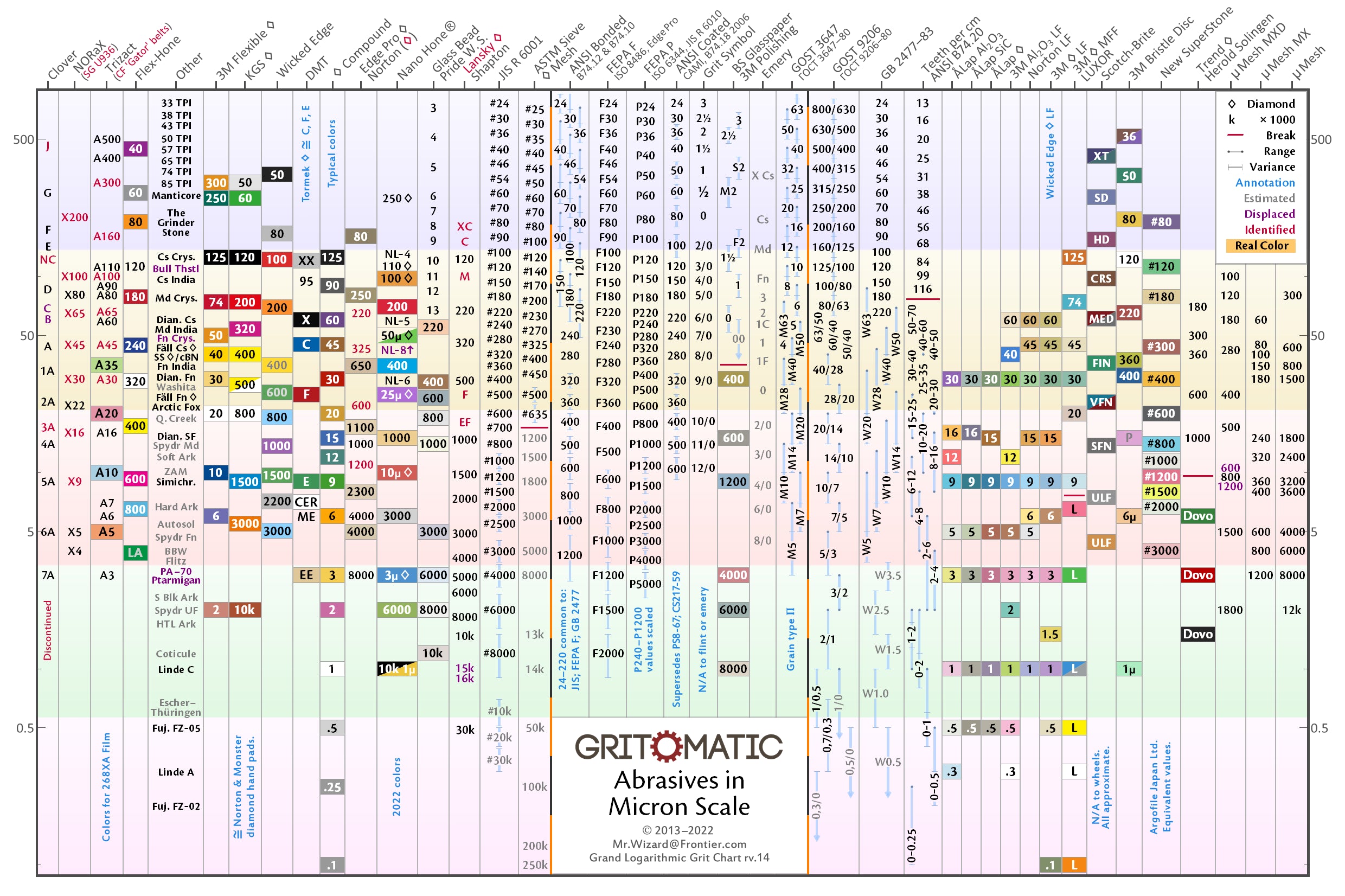
| Boride Series | Abrasive | Bond / Structure | Cutting Speed | Wear Resistance | Loading / Glazing Resistance | Scratch Character | Best Steel Range | Lubricant Preference | Best Use in Progression | Main Strength | Main Weakness |
|---|---|---|---|---|---|---|---|---|---|---|---|
| CS-HD | Silicon Carbide | Hard vitrified coarse-cut SiC | Very High | Medium | Good | Deep, aggressive, harsh | Hard wear-resistant steels | Water / Dry | Heavy reprofiling | Fastest Boride stock removal | Rough finish, harsh feedback |
| CS-WX | Silicon Carbide | Waterstone-like refined SiC bond | High | Medium | Very good | Cleaner and shallower than CS-HD | High-carbide steels, hard stainless | Water | Coarse-to-medium difficult steel sharpening | SiC speed with smoother finish | Still wears faster than premium AlOx |
| Ruby | Friable Aluminum Oxide | Fast releasing open bond | High | Medium-low | Excellent | Toothy, lively | Simple/tough steels | Water | Fast bevel establishment | Very responsive cutter | Dishes relatively fast |
| T2 | Premium Aluminum Oxide | Premium vitrified universal bond | High | High | Very good | Clean and even | Universal | Water | Main sharpening workhorse | Best all-around Boride | Not as aggressive as SiC on monster steels |
| Golden Star | Premium Aluminum Oxide | Refined premium bond | High | High | Very good | Slightly smoother than T2 | Universal | Water | Mid/fine sharpening | Excellent feedback | Less common grit availability |
| PC | Premium Aluminum Oxide | Dense finishing vitrified bond | Medium | High | Good | Bright semi-polishing | Medium-hard and hard steels | Water | Pre-finish / finish | Best conventional Boride finisher | Too slow for shaping |
| AS-9 | Aluminum Oxide | Dense oil-oriented vitrified | Medium-low | Very high | Moderate | Smooth bright | Simple steels | Oil preferred | Slow stable finish | Long life | Sluggish on water guided use |
| AM-K | Aluminum Oxide | Economy vitrified | Medium | Medium-high | Average | Basic utilitarian | Soft-medium steels | Water | Budget intermediate | Affordable filler | No premium traits |
Oil Behavior
| Tag | Short Definition |
|---|---|
| oil-retentive | Retains a stable working oil film on the stone surface |
| oil-wicking | Pulls oil into the stone body and dries the surface quickly |
Oil Behavior describes how a sharpening stone interacts with oil during use. The property is especially important for vitrified and resin-bonded stones because oil can either remain on the working surface or be absorbed into the stone body. Oil behavior affects sharpening feel, swarf evacuation, loading tendency, maintenance, and long-term stone cleanliness.
Oil-retentive stones keep a stable lubricating film on the surface during sharpening. This improves swarf mobility, reduces surface drying, and creates a smoother, more consistent sharpening feel. Oil-retentive stones are suitable for long-term use with honing oil.
Oil-wicking stones rapidly absorb oil into the internal structure through capillary action. The working surface dries quickly, swarf removal becomes less efficient, and oil contamination may become difficult or impossible to remove completely. Oil-wicking stones are generally better suited for water-based sharpening.


SKU: 036141WX
DISPONIBILITÉ: En stock (3 articles)
TYPE DE PRODUIT: 6" Mounted Sharpening Stone
MARQUE: Boride
Boride CS-WX Series stones are premium sharpening stones made of silicon carbide in a hard vitrified binder. Designed for slow breakdown and long service life, CS-WX combines aggressive cutting speed with a more controlled sharpening feel than conventional coarse silicon...

SKU: 036936X
DISPONIBILITÉ: En stock (26 articles)
TYPE DE PRODUIT: 6" Mounted Sharpening Stone
MARQUE: Boride
Boride Sharpening Stones are used for sharpening knives on Hapstone Pro sharpeners. Boride offers a wide range of stones with different performance values and different rates of wear. Boride stones are made of aluminum oxide, with the exception of CS-HD...

SKU: 036233X
DISPONIBILITÉ: En stock (27 articles)
TYPE DE PRODUIT: 6" Mounted Sharpening Stone
MARQUE: Boride
Boride Narrow Sharpening Stones are used for sharpening knives on Edge Pro sharpeners. Narrow stones (12 mm wide) are suitable for recurved blades. Boride offers a wide range of stones with different performance values and different rates of wear. All...

SKU: 036141X
DISPONIBILITÉ: En stock (12 articles)
TYPE DE PRODUIT: 6" Mounted Sharpening Stone
MARQUE: Boride
Boride Sharpening Stones are used for sharpening knives on Hapstone Pro sharpeners. Boride offers a wide range of stones with different performance values and different rates of wear. Boride stones are made of aluminum oxide, with the exception of CS-HD...

SKU: SET-BORIDE-6-CSWX-BOXED
DISPONIBILITÉ: En stock (2 articles)
TYPE DE PRODUIT: Sharpening Stone Set
MARQUE: Boride
Boride CS-WX Series 6-Stone Boxed Set includes six 6" silicon carbide sharpening stones: F120, F220, F320, F600, F800, and F1200 grit. Compared to the 5-stone set, the 6-stone progression offers smaller grit jumps and smoother scratch pattern transitions throughout the...